
By Eric Parnell
“Your friend is heavy, But he was ready And never stopped for a while, And while you were sleeping, He went on keeping the final line in his mind. It’s all right, it’s all right, it’s all right” –Tortoise and the Hare, The Moody Blues, 1970
The hare attracts all of the attention. Swift, fast, nimble, agile, and sleek, what’s not to love to watch. But just because the hare is fast, it doesn’t necessarily mean that it’s always going to lead. Sometimes, slow and steady wins the race.
So it goes with the U.S. stock market. Turn on the financial media on any given day, and all everybody talks about is growth investing. Technology, social media, artificial intelligence, transforming the way we live our lives, what’s not to love to watch. But just because some companies or an industry are changing the world, it doesn’t mean that their stock prices are always out front. Indeed, sometimes these companies can get caught napping in the grass for extended periods. And what segment of the market keeps lumbering along sure and steady to take the lead? Value stocks.
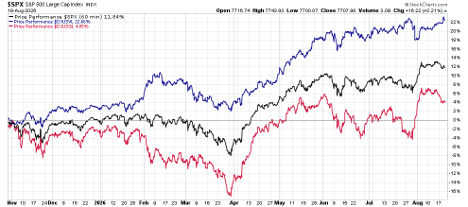
Such is the market environment we have been operating in for nearly a year now. If someone was not watching closely, they would understandably believe that it is the growth side of the market that continues to dominate. But consider the chart below, which shows the cumulative price return of the S&P 500 Index (black line) along with large cap value (blue line) and large cap growth (red line) dating back roughly ten months since Halloween last year. Not only is growth not leading the market, it’s lagging by nearly eight percentage points over this time period. Instead, it is value stocks that have been the primary driver of market gains over the last year, having outperformed the S&P 500 by more than ten percentage points on a price basis alone. Add in dividends and this leadership margin for value is even bigger.
Wait a minute, you might think to yourself. Sure, value stocks may be outperforming growth in recent months, but this is an anomaly, right? Growth has been killing it against value forever, so certainly value getting a moment to shine is nothing more than a blip on the radar screen. On the contrary, my friends. Consider the cumulative total return of the Russell 1000 Value versus the Russell 1000 Growth indices since the start of 2022 through today, which is a nearly five-year period. During this time, value stocks generated a total return of 68.04% versus growth stocks at 64.65%, a relative outperformance by value over growth of more than +3.3%. Moreover, value stocks achieved this relative outperformance with an annualized standard deviation (fancy way of saying risk – the lower the percentage the better) of 15.04% versus 19.77% for growth stocks. Relative outperformance with 25% less risk? Turns out the tortoise has been quietly killing it in its own right as all eyes remain on the sleek hare currently napping in the grass.
None of this is to say that investors should suddenly abandon their growth hare allocations and put all their money on the value tortoise. Absolutely not. But what it does highlight is the continued importance of remaining broadly diversified across all areas of the market. This includes styles such as growth and value, size such as large, mid, and small cap stocks, sectors that range from cyclical to defensive, and geography from the US to developed international and emerging markets. And not to be overlooked are also bonds, precious metals, and commodities that provide their own diversification benefit. For while all of the attention may be focused on the areas of the market that appears exiting and unbeatable, it is very often other areas of the market that may be getting little to no coverage today that are actually the true market leaders for an extended period of time.
Bottom line. While all of the attention in the financial news today may be on growth stocks, it has been value stocks that have been leading for some time now. Thus, investors should continue to maintain an eye on the benefits of diversification and not overlook the total return and risk control benefits that can come from allocating to both growth and value stocks over time.
Eric Parnell, CFA | Chief Market Strategist
Eric Parnell is the Chief Market Strategist for Great Valley Advisor Group. Eric applies his expertise in finance and economics to manage multi-asset portfolios, mitigate risk, deliver advice that promotes informed decision-making, and facilitate investors achieving their short-and long-term investment goals. He leads the GVA Asset Management platform overseeing the management of asset allocation models for GVA advisors and their end clients. Eric also provides economic, market, and investment related analysis and communications to the GVA network of advisors and clients as well as the broader financial media. Eric has appeared on CNBC, CNN, Money Matters TV, NPR-Marketplace, Seeking Alpha, and CFA Magazine.
Eric has more than 25 years of financial and investment experience. Prior to joining GVA, Eric was the Founder and Director of Gerring Capital Partners, a Registered Investment Advisor serving clients nationwide. Eric also previously served as the Director of Investment Communications for SEI Investments and as an Economist at Moody’s Analytics. Eric is also an active member of the CFA Society of Philadelphia and the Global Interdependence Center.
Disclosure: I/we have no stock, option, or similar derivative position in any of the companies mentioned, and no plans to initiate any such positions within the next 72 hours. I wrote this article myself, and it expresses my own opinions. I am not receiving compensation for it. I have no business relationship with any company whose stock is mentioned in this article.
Investment advice offered through Great Valley Advisor Group (GVA), a Registered Investment Advisor. I am solely an investment advisor representative of Great Valley Advisor Group, and not affiliated with LPL Financial. Any opinions or views expressed by me are not those of LPL Financial. This is not intended to be used as tax or legal advice. All performance referenced is historical and is no guarantee of future results. All indices are unmanaged and may not be invested into directly. Please consult a tax or legal professional for specific information and advice. LPL Compliance Tracking #1162805
The economic forecasts set forth in this material may not develop as predicted and there can be no guarantee that strategies promoted will be successful. All investing involves risk including loss of principal. No strategy assures success or protects against loss.